THE ESSENTIAL LIVING EDIT
The Ideas, Stories and Conversations That Shaped our First Year.

A year ago, I launched an experiment and called it Life Architecture. It might very well be (it’s still underway, mind you) the biggest experiment of my life.
The idea grew out of something I’d spent years doing: designing homes, products, and in many ways, myself. Designing taught me to think about how individual elements and pieces work together, how form and function interact, and how repeated refinement can turn an idea into something richer, more exacting. More beautiful.
It occurred to me that we could look at our lives much the same way.
After all, life is a grand design experiment.
We’re all works in progress, constantly shaped by our choices, our environments, our relationships, our rituals, our health and more, including the way we think. Life Architecture became a way to explore all of this.
We started with home and cooking because those are worlds I know intimately. But the real experiment was always about going deeper. Because beneath the beautiful rooms, objects, clothes, and food are the things that give them real meaning: discernment, connection, individuality and growth.
The experiment was rooted in my belief that we all have a very human desire to make something meaningful of our lives. And in order to do so, we have to access these deeper parts of ourselves.
Substack came along at the right time because it offered the perfect format for what I wanted to build. A place for longer, more in-depth pieces that could provide a framework for others to benefit from what I’ve learned.
Best of all, it gave Life Architecture a stage to explore what I call the stuff of life, both what we see on the surface and, more importantly, what lies beneath it, where the real essence of things often lives. With it, The Living Edit had found its home.
So here we are. One year later. I’m so happy you’re here and so appreciate you reading along and sharing your comments over the months. It’s helped me reconnect with my writer self, which has really been a joy. And more than anything else, I hope what I’ve written has provided value to you.
So without further ado, these were your favorite Substack articles from September 2025 to September 2026.
I think they provide a really good snapshot of where that experiment has taken us so far. But you be the judge!

One of my favorite articles began with a question I’ve thought about for years:
Have you ever wondered why some of us seem to be more affected by beauty than others? Why some people resonate deeply with it, while others seem almost oblivious to its force? Or why some seem to have an innate ability to create order and beauty around them?
I’m profoundly affected by beauty, so I’m probably not a fair person to ask. But whatever dulls our ability to notice it, whether distraction, circumstance, hardship or simply lack of exposure, I can’t imagine going through life without experiencing a sense of awe at something more beautiful or greater than ourselves. A landscape so beautiful it almost doesn’t look real. A piece of music that brings you to tears. A building so extraordinary you wonder how anyone ever conceived it.
I’ve been fascinated by beauty my whole life, and I mean beauty in its broadest sense: in people and nature, art and music, architecture and objects, the environments we create around us, and the qualities we cultivate within ourselves. But I wanted to understand why it matters so much. And frankly, to question why beauty needs defending at all.

Because beauty isn’t just about ornament. Sometimes beauty is precision. Sometimes it’s function. There is extraordinary beauty in a perfectly made tool, a beautifully proportioned room, a thoughtfully prepared meal. Beauty can be grand, but it can also be incredibly ordinary. It belongs to all of us.
And despite what we may have come to believe, I think we’re inherently wired for it.
If you look back far enough, beauty has always been there. It’s extraordinary, really. Humans were creating decorative objects tens of thousands of years ago, right alongside tools to survive. We were compelled to make things beautiful long before civilization as we know it.
Babies respond to attractive faces before culture could possibly have taught them. Beautiful music activates the brain’s reward system, while art, nature and beautiful environments can measurably affect how we feel.
Beauty isn’t simply decoration. It’s part of the human experience.
And I think that matters even more today. The flatter, faker and more virtual our world becomes, the more valuable the real, lived experience becomes too. We can dismiss beauty as superficial or confuse it with vanity, perfection or the impossible standards sometimes amplified by social media, but that misses the point.
Beauty gives dimension to life. We experience it, we feel it, and we have the ability to create it, both in the worlds we design around us and within ourselves. It can move us, restore us and connect us.
If life has taught me anything, it’s that beauty is a wonderful antidote to a loud world. I find comfort in knowing we’re wired for it. Seeking and creating beauty isn’t frivolous. It makes life richer.

My favorite place. And my favorite place to talk about. Home.
It's always fascinated me because it’s the stage for so many of the most important moments of our lives.
From childhood through adulthood, we move through homes that become part of our personal history. For some of us there are many; for others, only a few. But whether it’s the house we grew up in, the first place we lived on our own, or the home where we raised children, entertained friends, fell in love, grieved or simply lived an ordinary Tuesday, our environments have enormous potential to both reflect us and affect us.
When I first wrote about the idea of a new Domestic Era, I was interested in just how dramatically our relationship with home had changed. Looking at it today, I think the more interesting question may be where that change is taking us.
Because I think we are living through a new Domestic Era.

The average American now spends nearly two-thirds of every 24-hour period at home, more than 90 minutes longer than we did two decades ago. Home is no longer simply the place we return to after spending the rest of our day somewhere else. We work there. We exercise, eat, shop, entertain and restore ourselves at home now.
As a designer, I watched this transformation happen in real time during the pandemic as clients suddenly needed every square foot of their homes to do more.
But I think the more interesting question is what all of that convenience is doing to us. I’m concerned it’s making us more insular, more physically dormant, and I constantly wonder how we can optimize our homes to expand us rather than contract us. Because somewhere along the way, we began editing a lot of healthy friction out of our lives: the reasons to leave the house, move our bodies, encounter other people, experience something unexpected. Home became everything, and “everything” may simply be too much for any one space to hold.
A beautiful environment doesn’t automatically create a beautiful life. I often say home is a stage for our lives, but ultimately, it’s how we live within it that ultimately matters. And if our homes are holding more of us than ever before, they also have greater potential to shape us.
This, to me, is the opportunity of this new Domestic Era. Not more or less décor, but better design in the best possible sense: spaces, systems and rituals that encourage us toward better habits, greater curiosity, connection and growth.
Our homes can be extraordinary laboratories for living, but like everything in life, they’re meant to bring us balance. They should support us, bring people together, and give us a place to return to, but also know when to send us out into the world. They should expand us, not contain us.

There has probably never been a more interesting time to think about our health. Science, technology and increasingly AI have given us access to information about our bodies that would have been unimaginable not long ago. We can track how we sleep and recover, see how stress affects us, understand our metabolic responses to food, and bring technologies once confined to clinics, performance centers and spas directly into our homes.
It’s exciting. It can also be completely overwhelming.
When I wrote Next Level Health, I wanted to sort through some of the noise, simplify things and understand which of the many emerging tools and protocols might actually be useful.
I’ve spent years researching and experimenting with health and wellness, both personally and through designing homes and some very advanced spa for clients, and I keep coming back to the same idea: health has to support life, not compete with it.
The fundamentals remain remarkably unglamorous: sleep, nutrition, movement and stress regulation. No device, supplement or protocol replaces them. But what has changed enormously is the support architecture now being built around those basics, much of it now available to us at home.

In just the past several years, sauna and heat therapies have moved far beyond the spa, with growing interest around cardiovascular health, heat adaptation and recovery. Cold exposure has become a serious area of interest for stress tolerance, mood and recovery. Red light therapy is increasingly used for skin health and localized tissue support. Wearables now reveal patterns in sleep, recovery and heart-rate variability, while continuous glucose monitors allow us to see something even more personal: how our bodies really respond to food.
Nervous-system regulation and biofeedback have become another fascinating frontier. Who would have thought we’d have wearable devices helping us reduce stress and teaching our bodies, in real time, how to move more effectively between activation and recovery?

Then there’s an even more advanced edge, from hyperbaric oxygen therapy to cryotherapy, where the possibilities are compelling but the evidence, accessibility and appropriate use vary considerably. That distinction matters. New doesn’t automatically mean necessary, and emerging doesn’t always mean proven. But, we’re certainly moving in that direction, and it will be interesting to see where it takes us.
What fascinates me most, though, is how personal health is becoming. We have so many new ways to understand our patterns, responses and needs. I don’t think the goal is to track ourselves forever, own every device or turn wellness into a full-time job, but I do think there’s real value in many of these tools. If they can teach us things about ourselves that we eventually grow to know without them, then that’s a great thing.
Which may help explain why Next Level Health became the most-saved Living Edit of the year. There’s an extraordinary amount available to us now.
Take what’s useful. Build the healthiest life you can, but make sure you leave plenty of time to actually live it.
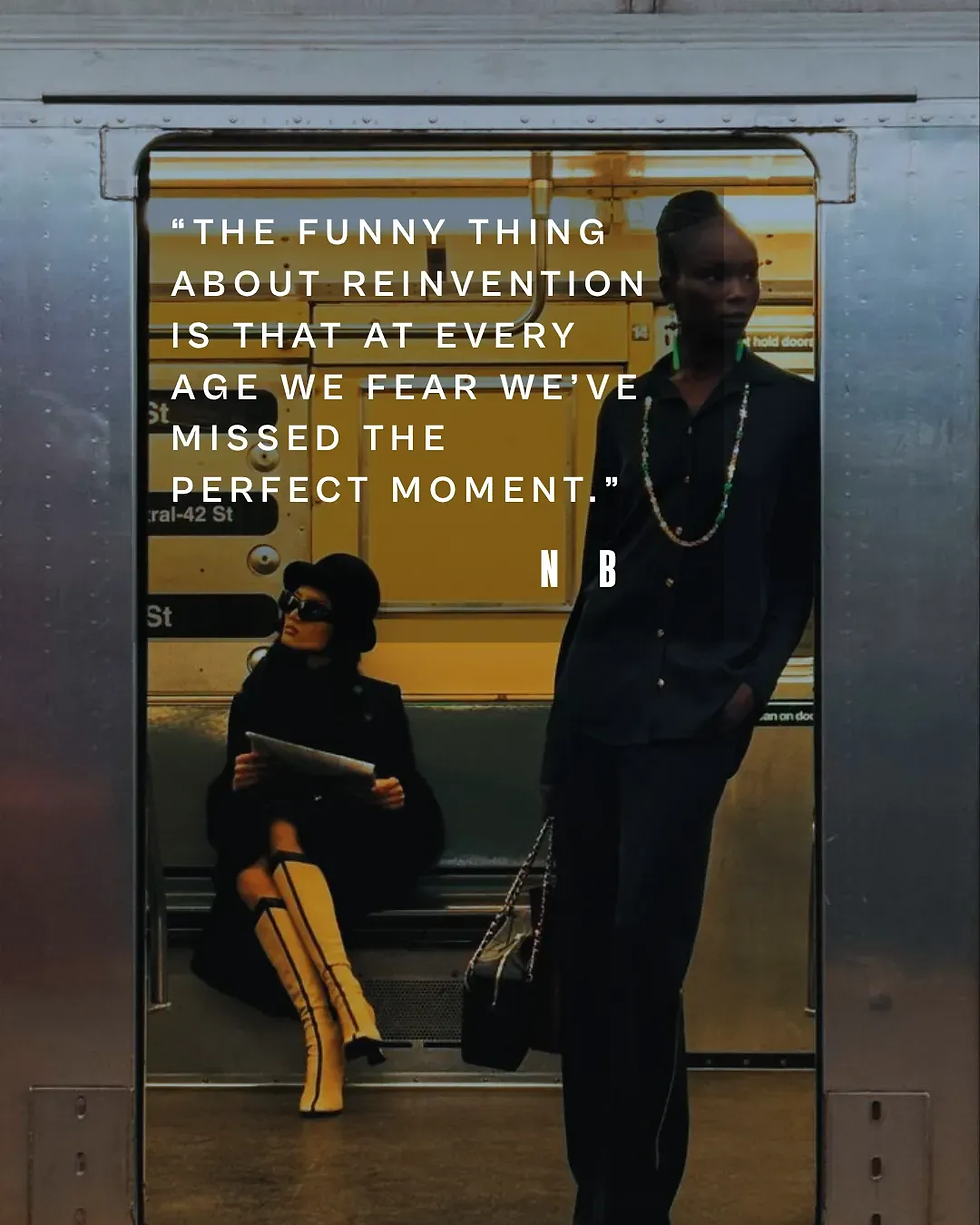
I think most of us carry around an invisible timeline for our lives. I know I do.
Where we thought we’d be by now. What we imagined we would have accomplished. Who we thought we would become.
And when life deviates from that plan, whether by choice, failure, circumstance or some curveball we never saw coming, it can feel surprisingly personal. We give ourselves permission to grow and succeed, yet we’re often far less generous about changing our minds, choosing another course or beginning again.
I happen to be right in the middle of one of those reinventions now. Launching Life Architecture meant stepping away from the certainty of being known for something I had spent years building to create something new, in public, without knowing exactly where it would lead.
It’s been exhilarating and inspiring, albeit uncomfortable and humbling. And while perhaps I’ll have much more to say about what this past year has actually been like, living through it has made me think deeply about why reinvention can be so difficult in the first place.
Maybe it’s because we don’t just build plans around our lives. We build identities around those plans.
Work can be particularly powerful. We become known for something, build expertise around it, and eventually what we do becomes deeply intertwined with who we believe we are. There’s enormous comfort in that certainty. Which is exactly why reinvention can feel like such a gut punch. Changing direction can somehow make us question whether everything that came before was wrong.
I’ve come to believe almost the opposite.
Every career, relationship, success, failure, place we’ve lived and version of ourselves we’ve been leaves something behind: knowledge, perspective, resilience, skill. Psychologist Patricia Linville’s research on self-complexity even suggests that having multiple dimensions to our identities can make us more resilient. When our entire sense of self isn’t dependent on one role or title, we have more of ourselves to draw upon when life changes.
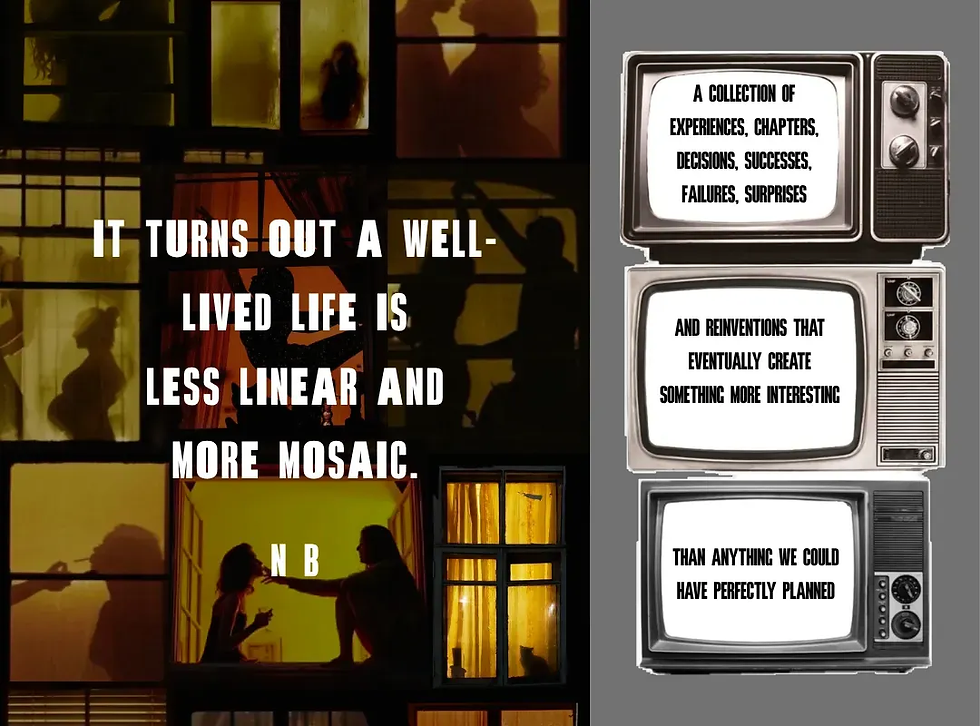
The difficult part is that reinvention asks us to become beginners again. As adults, we’re accustomed to knowing what we’re doing. Starting over requires trading some of that mastery for curiosity, certainty for learning and establishment for experimentation. It can feel like moving backward, even when it’s taking us somewhere entirely new.
And sometimes we don’t choose reinvention at all. Life chooses it for us. I’ve experienced both, and during some of the hardest moments of my own life, I’ve returned to three words: just land the plane. Get steady. Respond to what’s happening. Make the best decision you can. And move.
But perhaps the biggest realization of this particular reinvention has been that I’m not actually starting over.
I’m bringing everything forward: storytelling from my journalism days, design from my interiors and architecture practice, commerce from retail, and years spent studying homes, people and how we live. They are the mosaic of me. And Life Architecture, in many ways, is where all those seemingly disparate pieces have finally come together.
That may be the most important thing I’ve learned about reinvention so far: it isn’t necessarily about becoming someone entirely new. Sometimes it’s about recognizing that everything you’ve already been has been preparing you for what comes next.
There’s never a perfect time. But it can still be the right time. Because we never finish becoming.

Looking back, what still fascinates me about this article is how little intention most of us bring to something that has such an enormous influence on our lives: friendship.
We think carefully about our health, our work, our homes, our finances, even our personal growth. But friendship? Most of us leave it largely to chance. And today, when so much of our interaction happens through screens and many of the circumstances that once naturally brought us together have changed, I think that question is even more interesting: Are we actually building the relationships we want in our lives?
That question became personal for me when I came to a slightly uncomfortable realization: I’m a crap friend.
Not in the ways that really matter. I’m loyal, empathetic, trustworthy and genuinely care about the people I love. But I’m terrible at staying in touch. And while I’m enormously grateful for the wonderful friendships I’ve had throughout my life, I realized I hadn’t really made any meaningful new ones in years.
It made me start thinking about friendship differently. Most of our friendships are born through circumstance: school, work, children, neighborhoods, shared stages of life. Yet considering how profoundly the people around us influence the way we experience life, why wouldn’t we think just as intentionally about building our friendships?
Friendship, I came to believe, is part of our personal architecture too.
And apparently, building one really does take time. Researcher Jeffrey Hall found that it takes roughly 50 hours together to move from acquaintance to casual friend, about 90 hours to become friends and more than 200 hours to become close friends. Two hundred hours. Friendship isn’t all chemistry. It’s accumulated time, shared experience, trust, reliability and consistency.

Then there’s Robin Dunbar’s fascinating research showing just how limited our capacity for true closeness actually is. We may know hundreds or even thousands of people, particularly in the age of social media, but our deepest support system remains remarkably small: roughly five people, with around fifteen making up our closest circle. Technology may have dramatically expanded our networks. It hasn’t expanded our capacity for intimacy.
Which makes the quality of those relationships matter enormously.
The best friendships, to me, make us feel seen. There’s even a word for the ability to recognize another person’s emotional state without having to be told. It’s called attunement. It’s the friend who notices the change in your voice, remembers what you said three months ago or senses something is wrong before you ever say it. Deeply seeing another person, accepting them and continuing to love them may be one of the greatest gifts we can give another human being.
But perhaps what surprised me most was learning that friendship isn’t only tested when things go wrong. Researchers call it capitalization: our ability to genuinely celebrate another person’s good news. We tend to think a great friend is the one who shows up when our world falls apart. Just as revealing may be the friend who can clap the loudest when our world comes together.
The people I know who are truly gifted at friendship seem to share something else too: generosity of spirit. They remember. They give. They celebrate without comparison. They tell difficult truths, keep confidences, forgive, make time and show up, not only for the milestones, but for the ordinary days too.
Which made me realize that being a quality friend may be less something we are than something we practice.
Like taste, confidence or leadership, friendship is built from small, intentional behaviors practiced consistently over time. And because friendship, unlike family, is chosen, every meaningful friendship continues to exist because two people keep choosing one another.
That, to me, is what quality friends are about. Do the people around us make our lives more expansive and more human? And just as importantly, are we becoming the best kind of friends we can be?
THE GRAND DESIGN EXPERIMENT CONTINUES

Looking back at these stories together, I’m struck less by how different the subjects are than by how connected they’ve become.
Beauty, home, health, identity, friendship, taste. On the surface, they can look like entirely different conversations. But underneath, they’re really asking many of the same questions: What shapes us? What makes life richer? How much influence do we actually have over the person we become and the lives we create?
A year ago, I called Life Architecture a grand design experiment. I believed it then, but I have an even better understanding of what that really means today.
We can’t design everything that happens to us. But we can become more conscious about what we bring into our lives, what we cultivate, who we surround ourselves with and where we choose to place our attention.
And perhaps that’s what The Living Edit has really become: an exploration of the things that make a life feel more dimensional, meaningful and distinctly human.
Thank you for being here, for reading, responding, sharing your own stories and becoming part of mine.
I feel like we’re really just getting started.


Comments